Kitchen Exhaust Cleaning in Kingston
Kitchen Exhaust Cleaning in Kingston is the service that cleans the grease path after the hood ends: the horizontal duct above the ceiling, the riser that climbs to the roof, and the inlet of the rooftop fan. Kingston Hood Cleaning works through every access panel, scrapes each section it can reach, and checks the result against the NFPA 96 grease limit of 0.078 inches. Your signed certificate lists each section by name. A section that stays out of reach appears on it too, with the reason.
Commercial kitchen exhaust cleaning: the three parts past the hood
The horizontal run carries vapour sideways above the ceiling to the shaft. Grease settles on the duct floor and packs into each elbow.
The riser is the vertical leg. Grease condenses on its cooler walls and drains down, so the thickest layer sits at the bottom turn, the place you cannot see from the roof.
Access panels are the gasketed doors in the duct wall that let a technician in. Without them, a section cannot be cleaned or measured. Canopy and filter-bank work is on the hood cleaning services page. The fan itself is on the exhaust fan repair page.
Kitchen exhaust duct cleaning when the duct runs inside a chase or above a finished ceiling
An inaccessible duct section gets cleaned by cutting an access panel into it first, then scraping and measuring through that opening.
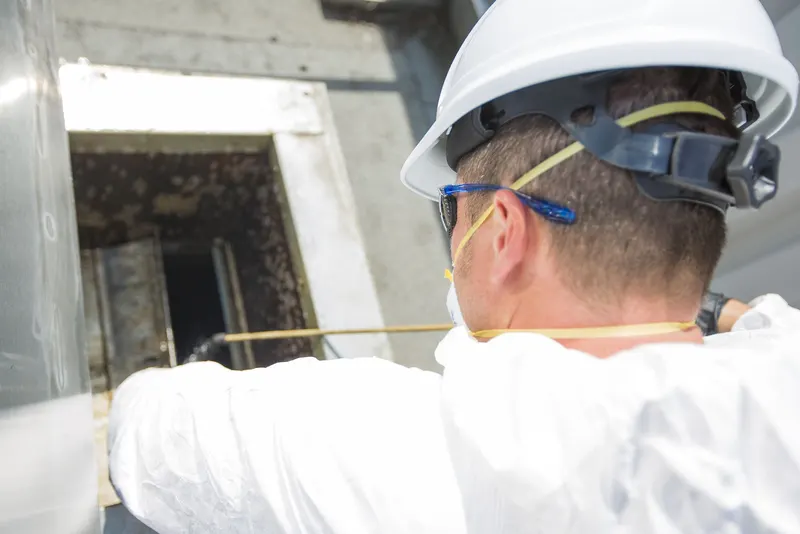
Hospital and campus kitchens ask this most often. A duct inside a drywall chase or above a finished ceiling often has no panels, so nobody has cleaned it.
The walk-through maps the run from the collar to the roof. Your facilities team then gets a written plan that shows where each new panel goes and what has to open to reach it: a ceiling tile, a drywall patch, or a service door in the chase.
On the visit, each new panel is fitted to the duct, the section behind it is scraped, and the grease depth is recorded. Drywall or ceiling repair stays with your own trades. The residence version of this is on the long-term care and healthcare page, and campus kitchens are covered on who we serve.
Hood-only vs full-system kitchen exhaust cleaning in Kingston
The difference shows in which sections each record names.
| Part of the path | Hood-only vs full-system: hood-only | Full-system |
|---|---|---|
| Collar | Reached from below, as far as an arm goes. | Cleaned through the first panel, depth recorded. |
| Horizontal run and elbows | Left closed. | Each panel opened, each elbow scraped and photographed. |
| Sections in a chase or above a finished ceiling | Not mentioned. | Mapped, with a panel plan, then cleaned once panels are in. |
| Riser base and fan inlet | Not reached. | Scraped from the bottom turn and from the roof. |
| Certificate | Names the hood. | Names every section cleaned and every section not reached. |
What the certificate asserts is explained on the NFPA 96 page.
Best kitchen exhaust cleaning services in Kingston for a shared riser in a plaza or a residence
A shared riser gets split on paper before anyone climbs to the roof: each kitchen owns its branch, the building owns the common riser.
Strip plazas along Princess Street, Division Street and Gardiners Road often put two or three food tenants on one shaft. Every tenant can hold a clean certificate for its own hood while the riser above the junction carries grease from all of them.
Your quote names the junction. Each branch from hood to junction goes on that tenant's certificate. The riser and the fan inlet get their own quote, addressed to the landlord or property manager, with proof of WSIB coverage and liability insurance supplied before work starts.
The 0.078 inch measurement along the whole path
NFPA 96 sets the acceptable grease depth at 0.078 inches. That figure applies to the duct and the fan as much as the hood. A full-system visit records it at four points: the collar, the outer wall of each elbow, the bottom of the riser, and the fan inlet.
Before-and-after photographs cover every cleaned surface. A section with no reading is never marked clean. It goes on the certificate as not accessible, next to the panel that would open it.
Kitchen hood filter cleaning and replacement
Hood filter cleaning happens on every visit, and a filter gets replaced when it can no longer do its job.
A bent baffle blade lets grease pass straight into the run. A frame that has warped from heat leaves a gap. A filter sized for another hood leaves open space at the end of the rail.
Each filter is pulled, degreased and checked. Any that fails the check is listed on your quote as a replacement before the visit, so you approve the cost first. The replacement goes in the same night and appears on the certificate.
Creosote from a smoker or a wood-fired oven
Wood smoke leaves creosote in the duct. It condenses on cooler metal, hardens into a glaze, and binds grease into it.
NFPA 96 publishes a monthly interval for solid-fuel cooking. A barbecue smoker, a pizza oven burning wood, or a charcoal grill puts your kitchen in that bracket. Solid-fuel duct work is quoted per job after inspection, because the creosote layer sets the hours.
Exhaust maintenance in Kingston, ON: finding kitchen exhaust cleaning services near me
Kingston Hood Cleaning handles duct runs from downtown Kingston out along Bath Road, Highway 15 and Highway 38, and east to Gananoque and Brockville.
Older downtown buildings tend to have long runs with few panels. The full coverage list is on the areas served page.
How much does kitchen exhaust cleaning cost in Kingston in 2026?
Kitchen exhaust cleaning in Kingston costs from $585 per visit for a single-hood kitchen up to ten feet and from $995 per visit for a multi-hood kitchen of two to four canopies. Hospital, campus, long-term care and shared-riser systems are quoted on site after a free walk-through.
Run length, elbow count, riser height and the number of usable panels set the hours on a full-system job. Each new panel is its own line on the quote. Your written quote comes back within 24 hours.
Next step: call 343-453-2343 or request a written quote. Tell us whether your duct runs through a chase or a finished ceiling and whether another kitchen shares the riser. Every other service is on the services page.
Kitchen exhaust cleaning services: frequently asked questions
Can a duct above a hospital ceiling be cleaned without tearing out the ceiling?
A duct above a finished ceiling can be cleaned through new access panels placed at each elbow and turn. Your own trades close the ceiling or chase afterwards.
Does the certificate cover the riser if my unit shares it with another restaurant?
The certificate covers the riser only when the riser is on the quote. A tenant certificate names the branch to the junction. The riser and fan inlet go on a separate quote to the building owner.
Where does grease build up most inside a kitchen exhaust duct?
Grease builds up most on the duct floor right after the collar, on the outer curve of each elbow, and at the bottom turn of the riser.
How do I know if my hood filters need replacing?
Hood filters need replacing when a blade is bent, the frame is warped, or the filter does not fit its rail.
Is a wood-fired pizza oven duct cleaned the same way as a fryer duct?
A wood-fired oven duct holds creosote as well as grease, so it is scraped by hand rather than degreased alone. NFPA 96 publishes a monthly interval for solid-fuel cooking, and the NFPA 96 page covers the full schedule.